
BreakoutOS is a no-code algorithmic strategy builder designed exclusively for breakout trading. It replaces the traditional workflow of writing code, running optimizations, and manually verifying results with an interactive, modular framework where you move from market analysis to validated strategy without typing a single line of code.
The BreakoutOS Framework: How It Differs from Traditional Platforms
Traditional development platforms try to do everything. They have thousands of features, 99% of which you will never use. Most of your time goes into figuring out how the platform works rather than actually building strategies.
BreakoutOS does one thing only - but it does it at a professional level. It is a complete framework for building, validating, and monitoring breakout trading strategies. Every module has a specific purpose and feeds into the next.
The framework splits into distinct phases:
- Find - Confirm your market has breakout trendiness and stamina
- Calibrate - Understand market personality and qualities
- Map - Identify the best windows of opportunity
- Build - Prototype breakout strategies using the Mr. Breakout's formula
- Test - Run filters, robustness checks, and cross-market validation
- Monitor - Track strategy health in live trading
You move from module to module in sequence. Each step builds on the previous one.
Step 1: Market Selection with Breakout Sonar
Before building anything, you need to confirm that your chosen market actually supports breakout trading. Many traders skip this entirely - they pick a market because it is popular or because someone recommended it, without verifying that it has the right characteristics.
BreakoutOS includes a Market Breakout Sonar module. You upload your market data (any CSV or ASCII export from any platform) and run the breakout suitability analysis. This proprietary analysis tells you two things:
- Whether the market has breakout trendiness and stamina - the fundamental requirement for any breakout strategy
- Whether to focus on day trading or swing trading - because a market can have strong stamina for swing trades but none for day trades, or vice versa
In our NASDAQ 60-minute test, the sonar showed no real stamina for day trading at the time, but above-average stamina for swing trading on the long side. That alone tells you exactly where to focus.
This kind of analysis saves you from the most common mistake in strategy development: building strategies for a market or timeframe that simply does not support the approach.
Step 2: Market Personality Calibration
Market qualities change over time. If you do not build separate strategies for different market conditions, your income will be inconsistent. You might make money during trending periods and give it all back during choppy ones.
The calibration module in BreakoutOS analyzes how your market's personality shifts across different periods. This is a proprietary process, but the practical output is that you understand which conditions your strategy needs to perform in - and you can build accordingly.
Step 3: Mapping Windows of Opportunity
The Market Mapper module helps you identify exactly when breakout opportunities occur in your market. This includes:
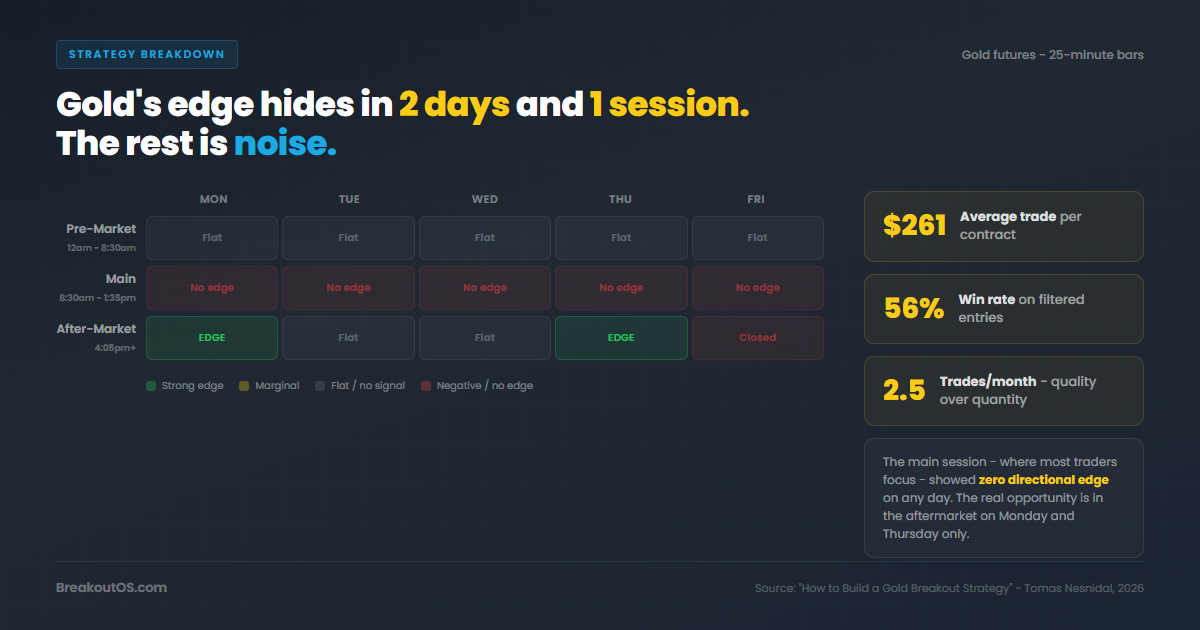
- Day-of-week analysis - Which days produce the strongest breakout moves? In our NASDAQ swing test, Monday and Tuesday were consistently the strongest, Wednesday was decent, and Thursday/Friday were weak.
- Session analysis - Should you enter during pre-market, regular hours, or after-market? Each produces fundamentally different results.
- Holding period analysis - How long should you hold? In our test, shorter holding periods (1-2 days) performed better than longer ones.
All of this is interactive. You toggle options and see results update in real time. No coding, no waiting for optimization runs. Within minutes, you know:
- Which market and direction (long or short)
- Day trading or swing trading
- Which days of the week
- Which session window
- Optimal holding period
That level of clarity before you even start building strategies puts you ahead of the vast majority of traders who are guessing at these parameters.
Step 4: Building with Mr. Breakout's Formula
Every strategy in BreakoutOS is built on the same proven formula: point of initiation, space (volatility), time, and filters.
The strategy builder is fully interactive. You set your point of initiation (yesterday's close, today's open, high or low of the day, a moving average), your space calculation (ATR with various lookback periods and multipliers), and your time constraints. As you adjust any parameter, the equity curve, trade list, and statistics update immediately.
This is what the platform calls "immersive backtesting." There is no cycle of code-compile-run-wait-verify. You move sliders and get answers in real time. Every combination you test is instant.
The builder also helps you identify which formula components work best for your specific market and timeframe. Each market responds differently to different points of initiation and space calculations. The platform helps you isolate the ones that matter.
Step 5: Filter Testing
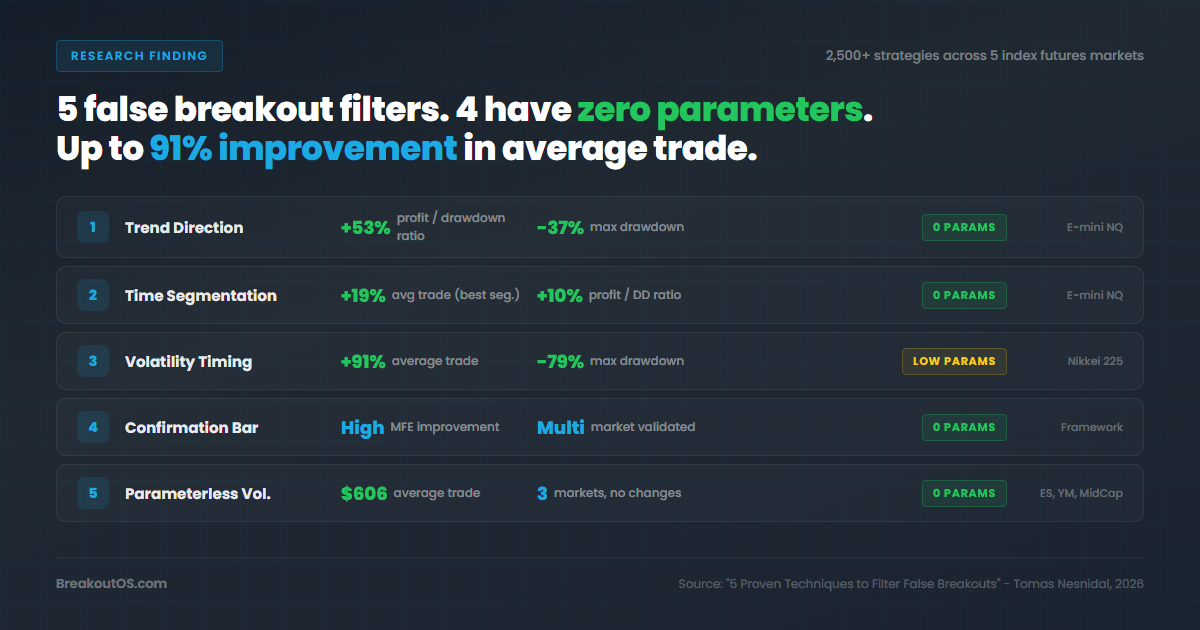
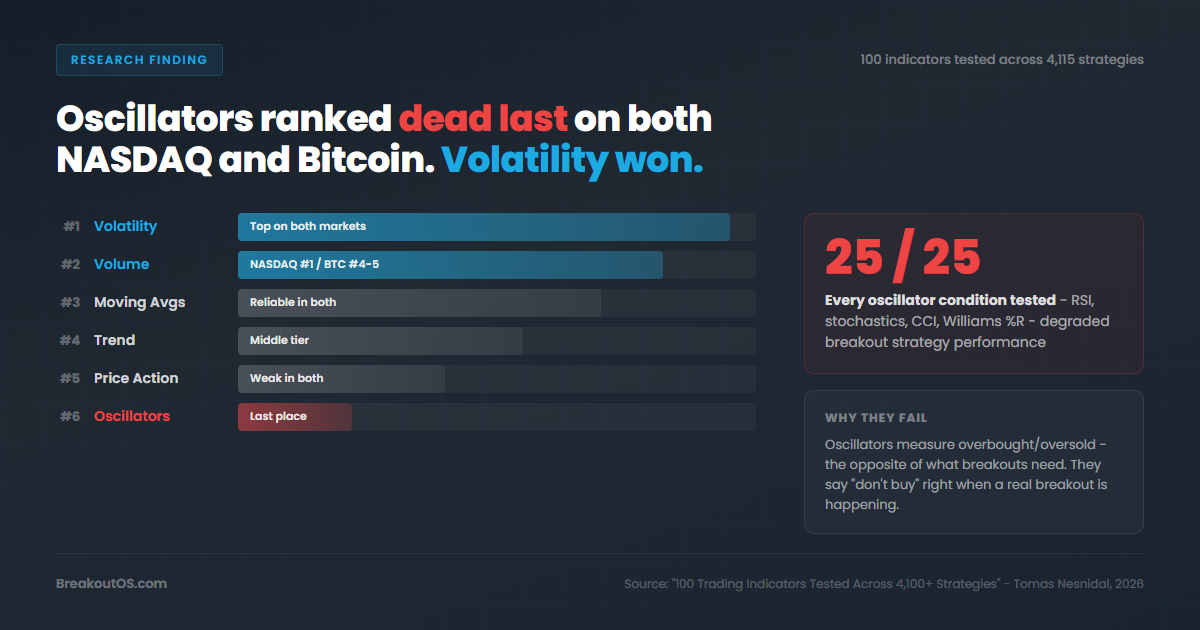
Once you have a working prototype, you test filters to remove losing trades while keeping winners. BreakoutOS includes a filter testing module where you can evaluate various conditions against your prototype.
Common filters include day-of-week exclusions, volatility thresholds, and trend conditions. The platform shows you exactly how each filter affects performance - how many trades it removes, what happens to the win rate, and whether the equity curve improves.
The key principle is that filters are applied after you have a solid foundation, not before. Adding filters to a weak model just hides the weakness temporarily.
Step 6: Robustness Testing and Validation
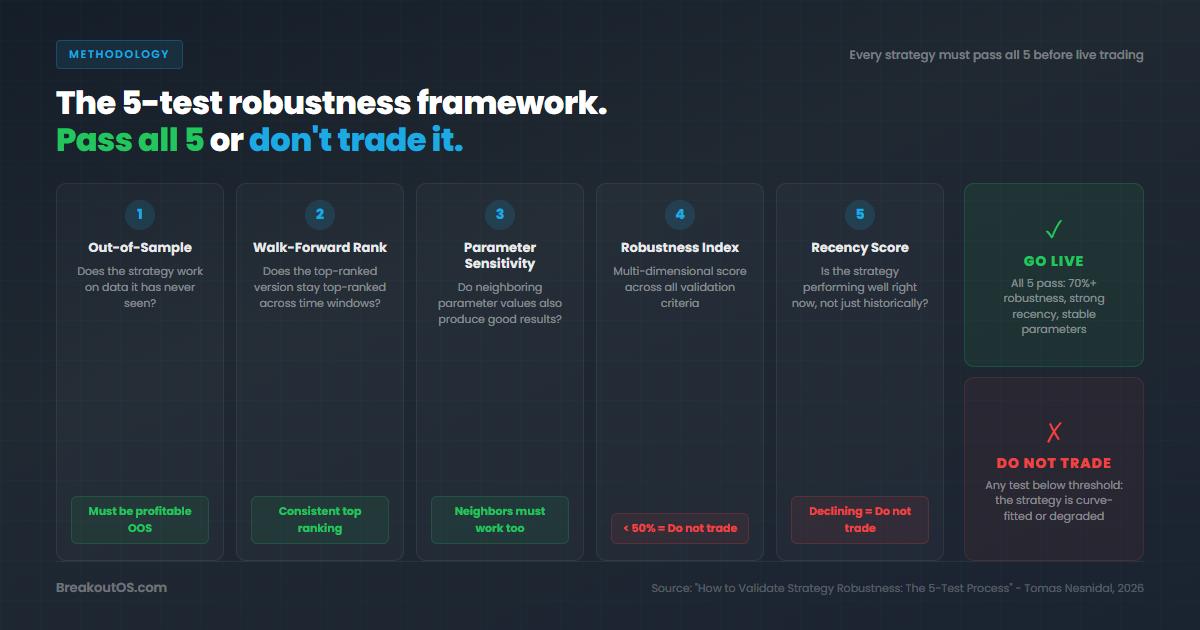
BreakoutOS includes a full suite of robustness tests - out-of-sample validation, neighbor values analysis, walk-forward rank stability, proprietary robustness scoring, and recency performance indexing. You run these sequentially, and each test gives you a clear pass or fail.
Step 7: Live Strategy Monitoring
After deployment, the Strategy Health Monitor tracks whether your live strategy is performing within expected parameters. This addresses the constant question every algorithmic trader faces: is my strategy failing, or is this just a normal drawdown?
The health monitor uses proprietary metrics to distinguish between expected variance and genuine deterioration. It tells you when to stay the course and when to consider replacing a strategy.
The Complete Workflow Timeline
Here is what a typical strategy development session looks like in BreakoutOS:
- Minutes 1-3: Upload data, run breakout sonar, confirm market suitability
- Minutes 3-5: Map windows of opportunity (days, sessions, holding periods)
- Minutes 5-15: Prototype strategies, test combinations, identify top candidates
- Minutes 15-25: Run robustness tests on top candidates
- Minutes 25-35: Cross-market validation on 5+ related instruments
- Minutes 35-45: Add filters and finalize the strategy
A full development cycle - from blank slate to validated, filter-refined strategy - takes under an hour. The traditional approach of coding, running overnight optimizations, and manually verifying results typically takes days or weeks.
See BreakoutOS in Action
Watch a full strategy build from blank slate to validated model.
Watch Demo Videos →Frequently Asked Questions

About the Author
Tomas Nesnidal, known to the systematic trading community as Mr. Breakouts, is a breakout trading specialist, hedge fund co-founder, and creator of BreakoutOS. He has managed institutional portfolios using breakout strategies for over 15 years, trading from 65+ countries. He is the author of The Breakout Trading Revolution and co-founder of Breakout Trading Academy.