
Most trading indicator research follows the same pattern: someone tests one indicator on one strategy, gets a good backtest, and declares it the best. That tells you almost nothing. I tested 100 different indicator conditions across 4,115 breakout strategies - 3,500 on the NASDAQ and 615 on Bitcoin. Every strategy was split into in-sample and out-of-sample periods. Every indicator was measured across multiple dimensions simultaneously. The sample size is large enough that the results are statistically meaningful, not anecdotal.
Why This Study Exists
Most trading indicator research follows the same pattern: someone tests one indicator on one strategy, gets a good backtest, and declares it the best. That tells you almost nothing. A single test on a single strategy is just noise dressed up as signal.
I wanted to answer a different question. Not "which indicator looks good on one cherry-picked setup," but "which indicators consistently improve performance when applied across thousands of independent strategies, on different markets, validated on unseen data?"
To get that answer, I tested 100 different indicator conditions across 4,115 breakout strategies - 3,500 on the NASDAQ and 615 on Bitcoin. Every strategy was split into in-sample and out-of-sample periods. Every indicator was measured not just on profit, but on multiple dimensions simultaneously. The sample size is large enough that the results are statistically meaningful, not anecdotal.
Methodology
Generating 100 Indicator Conditions
I used Gemini AI to generate 100 different filter conditions written in EasyLanguage for TradeStation. Each condition was its own standalone case with unique input parameters - lookback periods, thresholds, multipliers.
It took about an hour to clean everything up. Gemini produced duplicates, some nonsensical conditions, and a few that would not compile. After cleanup, I had 100 usable filter conditions organized into six categories:
| Category | Number of Conditions | Examples |
|---|---|---|
| Moving Averages | 15 | Simple, exponential, weighted MA crossovers and comparisons |
| Oscillators | 25 | RSI, stochastics, and similar bounded indicators |
| Price Action | 15 | Raw price patterns, candle relationships, bar range |
| Trend | 15 | ADX, directional indicators measuring trend strength |
| Volatility | 15 | ATR, standard deviation, measures of price dispersion |
| Volume | 15 | Trading volume and volume-price relationships |
Oscillators had the most conditions (25) because they represent the most popular and varied category among retail traders. Every other category had 15 conditions each.
The Testing Framework
The testing approach is what separates this from typical indicator studies. I did not test these filters on one strategy and call it a day. That approach is useless.
Step 1: Using the Mr. Breakouts Formula, I prototyped thousands of breakout strategies without any filters applied. These served as the baseline. The NASDAQ study used 60-minute data with approximately 15 years of history. The Bitcoin study used 60-minute data as well.
Step 2: Each baseline strategy was then tested with each of the 100 filter conditions applied on top. This produced 3,500 strategy variations on NASDAQ and 615 on Bitcoin.
Step 3: Every strategy was split into in-sample and out-of-sample periods. On the NASDAQ study, the last four to five years were reserved entirely for out-of-sample testing - meaning the strategies had never seen that data during development.
Step 4: The Bitcoin strategies were generated using genetic evolution, which explores a much wider range of possible setups than manual testing.
The Uplift Index
The key metric is the Uplift Index - a proprietary composite score inside BreakoutOS that measures overall improvement across multiple dimensions simultaneously:
- Net profit - did the filter increase total returns?
- Return ratio - did risk-adjusted returns improve?
- Win percentage - did the filter produce more winning trades?
- Average trade - did each trade capture more profit on average?
- Max drawdown - did the filter reduce peak-to-trough losses?
The Uplift Index rolls all of these into a single number. It does not just ask "did the filter make more money?" It asks "did the filter make the strategy better in every meaningful way?"
Additionally, a Robustness Index compares in-sample and out-of-sample performance to identify whether an indicator's edge carries forward into unseen data or is just curve-fitted noise.
Category Rankings: NASDAQ Results
Across 3,500 NASDAQ strategies, the cluster analysis produced clear winners and losers.
| Filter Category | In-Sample Performance | Out-of-Sample Performance |
|---|---|---|
| Volume | Positive uplift | Positive uplift |
| Moving Averages | Positive uplift | Positive uplift |
| Oscillators (25 conditions) | Negative - made results worse | Mixed |
| Price Action | Negative - made results worse | Mixed |
| Trend | Negative - made results worse | Mixed |
| Volatility | Negative - made results worse | Mixed |
Only two categories showed consistent positive uplift both in-sample and out-of-sample: volume and moving averages. Every other category - including oscillators, which had the most conditions at 25 - actually made strategies worse in-sample. That is not marginal underperformance. They actively degraded results.
When looking at all four scoring dimensions (in-sample uplift, out-of-sample uplift, robustness, and total score), volume indicators dominated:
| Rank | Indicator Cluster | In-Sample Uplift | Out-of-Sample Uplift | Robustness | Total Score |
|---|---|---|---|---|---|
| 1 | Volume | Highest | Highest | Highest | #1 |
| 2 | Volatility | High | High | High | #2 |
| 3 | Trend | Moderate-High | Moderate-High | Moderate-High | #3 |
| 4 | Moving Averages | Moderate | Moderate | Moderate | #4 |
| 5 | Oscillators | Moderate | Low-Moderate | Low-Moderate | #5 |
| 6 | Price Action | Low-Moderate | Low | Low | #6 |
The logic makes sense once you think about it. Breakout trading is fundamentally about conviction. When price breaks out of a range, you need to know whether that move has real participation behind it or whether it is a fake-out. Volume tells you that. Price alone cannot.
Category Rankings: Bitcoin Results
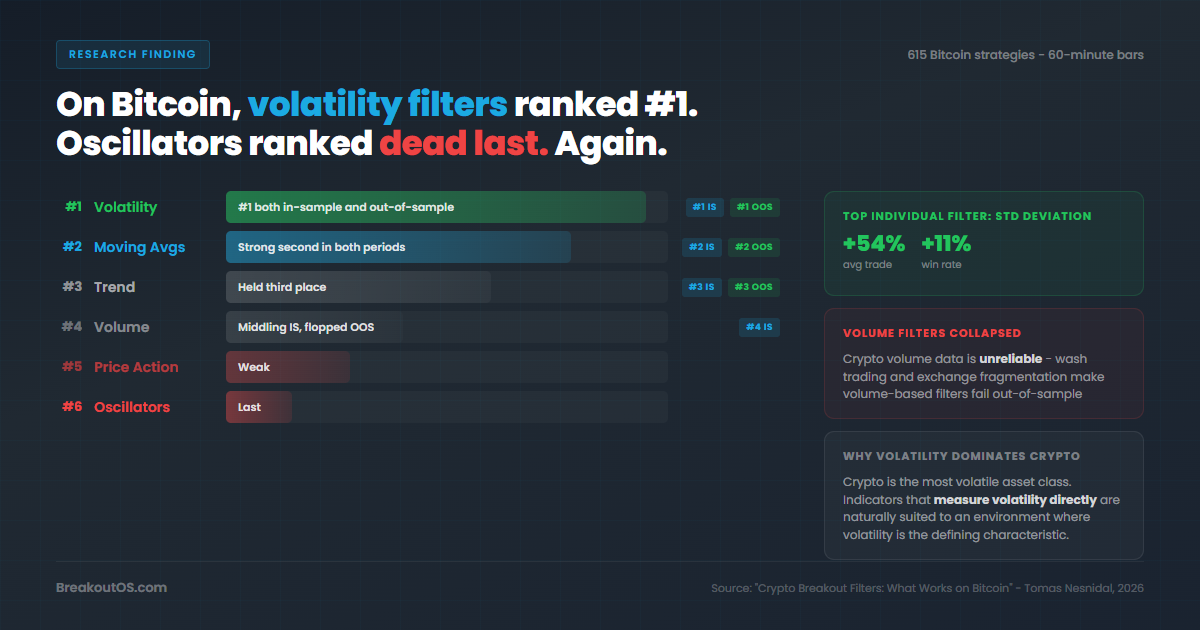
The Bitcoin study across 615 strategies told a different story - and that difference itself is one of the most important findings.
| Rank | In-Sample | Out-of-Sample |
|---|---|---|
| 1 | Volatility | Volatility |
| 2 | Moving Averages | Moving Averages |
| 3 | Trend | Trend |
| 4 | Volume | Price Action |
| 5 | Price Action | Volume |
| 6 | Oscillators | Oscillators |
Volatility-based indicators took the number one spot both in-sample and out-of-sample. This makes complete sense. Crypto is the most volatile asset class most traders will ever touch. Indicators that directly measure and respond to volatility are naturally suited to an environment where volatility is the dominant characteristic.
Moving averages came in a strong second in both periods. Combined with volatility indicators, these are the two most reliable filter categories for crypto breakout strategies.
Volume indicators had an interesting failure mode. They were middling in-sample but actually flopped out-of-sample. Crypto volume data is unreliable due to wash trading and exchange fragmentation, which likely explains why volume-based filters do not generalize well on Bitcoin.
Oscillators finished dead last in both periods. Again.
Download This Article as a PDF
Get the complete article in a clean, printable format.
Free download. We'll send the PDF to your inbox. You'll also receive future updates. Unsubscribe anytime.
Check your email
Your PDF is on its way. Check your inbox (and spam folder, just in case).
Cross-Market Comparison
Here is where the data gets genuinely useful. Looking at both markets side by side reveals which patterns are universal and which are market-specific.
| Category | NASDAQ Rank (Total Score) | Bitcoin Rank (IS + OOS) | Consistent? |
|---|---|---|---|
| Volatility | #2 | #1 | Yes - top tier in both |
| Moving Averages | #4 (but positive uplift IS+OOS) | #2 | Yes - reliable in both |
| Volume | #1 | #4-5 (flopped OOS) | No - NASDAQ only |
| Trend | #3 | #3 | Yes - middle tier in both |
| Price Action | #6 | #4-5 | Weak in both |
| Oscillators | #5 | #6 | Yes - bottom tier in both |
Three universal findings emerge from this comparison:
- Volatility indicators work everywhere. They ranked #1 on Bitcoin and #2 on NASDAQ across all scoring dimensions. ATR and bar range appeared among the top performers in every test I ran, regardless of market.
- Oscillators fail everywhere. RSI, stochastics, and their variants consistently degraded breakout strategy performance on both NASDAQ and Bitcoin. This is not a fluke specific to one market. Oscillators are structurally unsuited to breakout trading.
- Volume is market-dependent. Volume indicators dominated on NASDAQ where volume data is clean and reliable. On Bitcoin, they collapsed out-of-sample - likely because crypto volume data is distorted by wash trading and fragmented across exchanges. If you trade assets with reliable volume data, volume indicators are powerful. If you trade crypto, be cautious.
Top Individual Indicators
#1 Overall: Bar Range / ATR (Conditions 58 and 100)
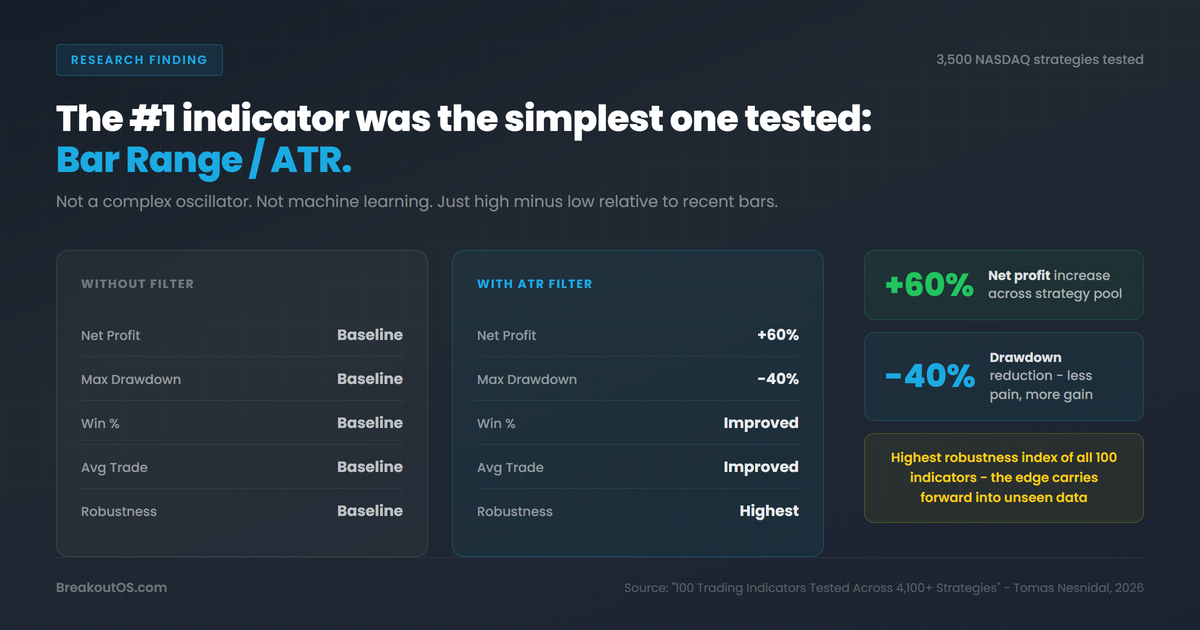
The single best indicator across the entire study was not a complex AI-generated oscillator. It was not a machine learning signal. It was conditions 58 and 100 - both measuring the same thing: bar range relative to ATR.
The implementation is almost embarrassingly simple. Take the high minus low of a bar, or calculate the average true range over some lookback period. Compare it to a threshold or a different period's value. That is it.
NASDAQ performance when applied as a filter:
- Max drawdown decreased by 40%
- Net profit improved by 60%
- Win percentage improved
- Average trade improved
- Highest robustness index of any filter tested
This indicator has been around for decades. It measures something fundamental about market behavior - how much a bar has expanded or contracted relative to its recent history. On both NASDAQ and Bitcoin, ATR and true range consistently appeared at the top of every ranking. The most important finding was robustness. Bar range and ATR had the highest robustness index of any filter tested. That means the improvement you see in-sample actually correlates with improvement out-of-sample. It is not curve-fitted. The edge carries forward into unseen data.
#2 Overall: Money Flow Index (MFI)
Within the volume cluster on NASDAQ, one indicator stood out: the Money Flow Index. MFI scored the second highest total score across all 100 indicators tested - across every moving average, every oscillator, every trend indicator, every volatility measure.
Unlike pure volume indicators that only look at how many shares changed hands, MFI combines both price and volume data. It measures the flow of money into and out of an asset by weighting volume with price direction.
NASDAQ out-of-sample performance with MFI filter:
- Net profit improved
- Max drawdown improved by 32%
- Average trade improved
- Win percentage improved
Every metric improved simultaneously. In nearly two decades of developing breakout strategies, it is extremely rare to find a single filter that improves every key metric at the same time. Usually there is a trade-off. The specific implementation: MFI with period 14, then a 30-period moving average of the MFI itself. Compute the percentage difference between the raw MFI and its moving average. If the percentage difference is above your threshold, conditions favor a long entry. The percentage-based calculation is critical for cross-market compatibility.
#3 Bitcoin-Specific: Standard Deviation (Condition 56)
The second-best individual indicator on Bitcoin was a specific standard deviation condition - comparing the standard deviation of the closing price to its own moving average.
Bitcoin performance numbers:
- Average trade improved by 54%
- Win percentage improved by 11%
- Net profit / drawdown ratio improved by 4.33%
A 54% improvement in average trade size means filtered trades were more than half again as profitable as unfiltered trades. Both the #1 and #2 best individual indicators on Bitcoin are volatility measures. This is not coincidence - it is the central finding of the crypto study.
The Oscillator Trap
This deserves its own section because it contradicts what most traders believe.
Oscillators - RSI, stochastics, CCI, Williams %R, and their variants - are by far the most popular indicators among retail traders. They had the most conditions in the study (25 out of 100). They are taught in every trading course. They appear on every charting platform's default setup.
And they consistently made breakout strategies worse.
On NASDAQ (3,500 strategies): oscillators produced negative uplift in-sample and mixed results out-of-sample. As a category, they ranked #5 out of 6.
On Bitcoin (615 strategies): oscillators finished dead last - #6 out of 6 - in both in-sample and out-of-sample testing.
This is not a marginal underperformance. Oscillators actively degraded results. If you are using RSI or stochastics to filter your breakout trades, the data from 4,115 strategies says you should seriously reconsider.
Why oscillators fail on breakouts:
Oscillators are designed to identify overbought and oversold conditions. They work best in ranging, mean-reverting environments. Breakout trading is the exact opposite - you are looking for directional moves that push beyond established ranges. An oscillator that says "overbought" during a legitimate breakout is telling you to avoid the very move you should be taking. The tool is fundamentally mismatched to the task.
Key Findings
- Volatility indicators (ATR, true range, standard deviation) are the most universally effective filters for breakout strategies. They ranked #1 on Bitcoin and #2 on NASDAQ, with the highest robustness scores across both markets.
- Bar range / ATR is the single best individual indicator tested. Across 3,500 NASDAQ strategies, it reduced max drawdown by 40% and improved net profit by 60%. It also had the highest robustness index, meaning the edge is not curve-fitted.
- Oscillators (RSI, stochastics) consistently degrade breakout strategy performance. They ranked last or near-last on both NASDAQ and Bitcoin. This finding held across 4,115 total strategies.
- Volume indicators are powerful on markets with clean data (NASDAQ) but unreliable on crypto. The Money Flow Index ranked #2 overall on NASDAQ, improving every performance metric including a 32% drawdown reduction. On Bitcoin, volume filters collapsed out-of-sample.
- Moving averages are the most consistently reliable secondary filter across all markets. They showed positive uplift on both NASDAQ and Bitcoin, in-sample and out-of-sample.
- Simple indicators outperform complex ones. The best filter found across 100 conditions was something that has been around for decades - high minus low relative to recent bars. Complex oscillator conditions with many parameters fit historical data beautifully but break in live trading.
- Testing across many strategies is essential. If a filter only helps one specific strategy, it is probably curve-fitted. The Uplift Index approach - measuring aggregate improvement across hundreds or thousands of strategies - separates real edge from noise.
- In-sample results without out-of-sample validation are meaningless. Several indicator categories looked reasonable in-sample but fell apart on unseen data. Without proper out-of-sample testing, you are just curve-fitting.
- Market characteristics should guide indicator selection. Crypto's extreme volatility makes volatility indicators naturally dominant. NASDAQ's reliable volume data makes volume indicators effective. Match the indicator to the market's defining property.
- The irony of using AI to generate indicators is that AI's best output was the simplest condition it produced. Markets are driven by relatively simple forces. You do not need a neural network to measure whether a bar is big or small relative to recent bars.
See BreakoutOS in Action
Watch a full strategy build from blank slate to validated model.
Watch Demo Videos →Frequently Asked Questions

About the Author
Tomas Nesnidal, known to the systematic trading community as Mr. Breakouts, is a breakout trading specialist, hedge fund co-founder, and creator of BreakoutOS. He has managed institutional portfolios using breakout strategies for over 15 years, trading from 65+ countries. He is the author of The Breakout Trading Revolution and co-founder of Breakout Trading Academy.
Download This Article as a PDF
Get the complete article in a clean, printable format.
Free download. We'll send the PDF to your inbox. You'll also receive future updates. Unsubscribe anytime.
Check your email
Your PDF is on its way. Check your inbox (and spam folder, just in case).