
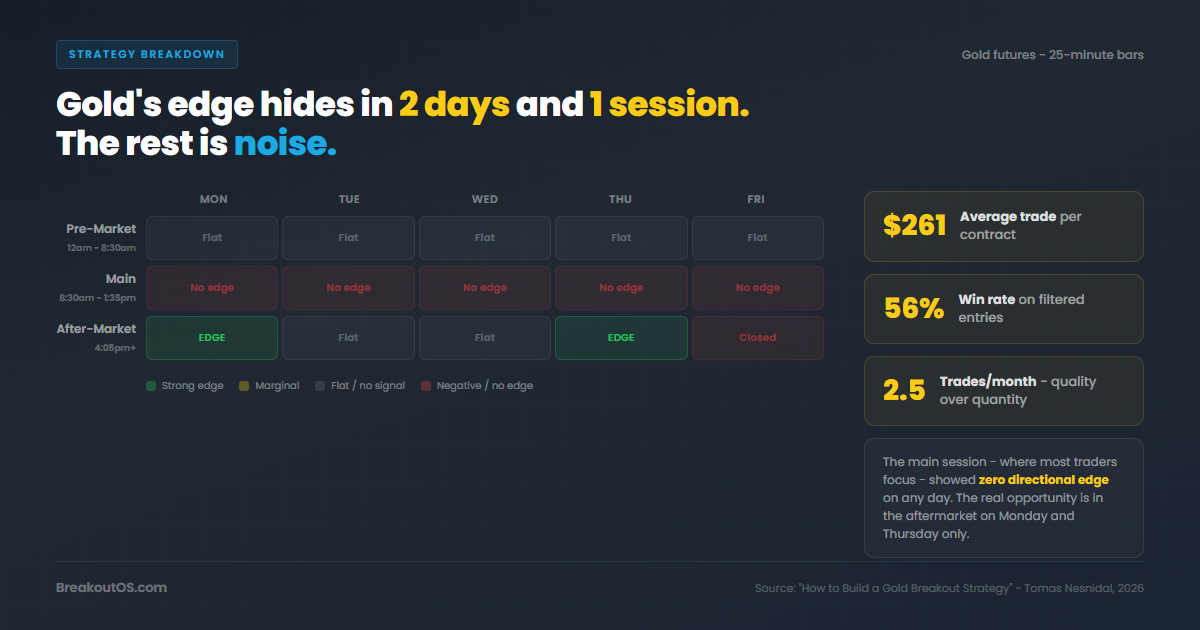
A gold breakout strategy built in BreakoutOS targets the aftermarket session (after 4:05 PM Chicago time) on Mondays and Thursdays, using a 20-period moving average as the point of initiation, ATR with a 2.5 multiplier for the breakout level, and an end-of-day exit. This specific configuration produced a 56% win rate and $261 average trade per contract across tested data.
Why Gold Requires a Different Approach Than Indexes
Most traders assume the main trading session is where the edge lives. On gold, that assumption is wrong.
Gold futures trade nearly around the clock, and the behavior across different sessions is profoundly different. When I loaded 25-minute gold futures data into BreakoutOS and ran the Market Mapper's volume analysis, the session boundaries became clear:
- Main session volume spike: 8:35 AM Chicago time
- Peak volume: 10:15 AM
- First session close: 1:35 PM (official end)
- Secondary drop: 4:05 PM (index session wind-down)
- After session: Low-volume period following 4:05 PM
The surprise was what happened when I tested for directional bias within each session. The main session (8:30 AM to 1:35 PM) showed no clean tendency on any day of the week. Monday through Friday - nothing usable. The pre-market (midnight to 8:30 AM) was equally flat for long trades.
The edge was hiding in the aftermarket, after 4:05 PM. And it was not hiding quietly.
How BreakoutOS Isolates Session-Specific Edges
This is where the BreakoutOS workflow separates itself from manual analysis. In the Breakout Sonar, you can map any session window and immediately see whether a directional tendency exists, broken down by day of the week.
For the gold aftermarket session, the day-by-day breakdown revealed:
- Monday: Strong long tendency
- Tuesday: No usable bias
- Wednesday: No usable bias
- Thursday: Strong long tendency
- Friday: No after session (gold closes around 1:30 PM on Fridays)
Two days. Monday and Thursday aftermarket. That is specific, testable, and immediately actionable in BreakoutOS's Backtester.
Building the Strategy Step by Step
With the session and day-of-week edge identified, the strategy construction followed the standard BreakoutOS workflow:
Initial Prototype
- Direction: Long only
- Entry window: 4:05 PM to 11:50 PM
- Exit: End of day at 11:50 PM (day trading strategy)
- Days: Monday and Thursday only
- Point of Initiation: End-of-day close (4:05 PM)
- ATR Period: 14
- Space Multiplier: 2
The first prototype using the end-of-day close as the point of initiation did not produce great results on Thursday. So I tested a different point of initiation - a 20-period simple moving average on the main timeframe. The result was dramatically better. Thursday looked strong, and Monday matched.
This is a detail that matters. The point of initiation is not always the same across markets. On NASDAQ, yesterday's close works well. On gold aftermarket, a moving average captures the relevant price context more effectively. BreakoutOS lets you test these alternatives in seconds without recoding anything.
Final Strategy Parameters
| Parameter | Value |
|---|---|
| Instrument | Gold Futures |
| Timeframe | 25 minutes |
| Direction | Long only |
| Entry Window | 4:05 PM - 11:50 PM Chicago |
| Exit | End of day (11:50 PM) |
| Days | Monday and Thursday only |
| Point of Initiation | 20-period SMA |
| ATR Period | 14 |
| Space Multiplier | 2.5 |
| Win Rate | 56% |
| Average Trade | $261 per contract |
| Monthly Frequency | ~2-2.5 trades per month |
Calibrating the Breakout Space on Gold
The Breakout Space Calibrator confirmed that a multiplier of 2.5 produced the best net profit to drawdown ratio, with high confidence on the Breakout Singularity Confidence Index.
Critically, the neighboring values (2.25 and 2.75) also produced good results. This is exactly the robustness profile you want. If the only good parameter is a single number with poor results on either side, that is a red flag for overfitting. When a range of values all work, the edge is structural, not accidental.
Why the Aftermarket Edge Exists
There is a logical reason the aftermarket session on gold produces a clean long tendency on specific days. After 4:05 PM, most institutional traders and index-correlated algorithms have stepped away. Thinner liquidity means fewer competing participants. For retail and smaller traders, this is an advantage - you are trading in a window where large hedge fund algorithms are not actively compressing the edge.
This is not a theory. The data confirms it. And BreakoutOS's session analysis makes this kind of structural edge visible rather than something you have to guess at.
What Comes After the Base Strategy
This is a viable prototype, not a finished strategy. The next steps in the BreakoutOS workflow would be:
- Run the Filters Tester to find conditions that improve win rate and reduce drawdowns
- Implement a protective stop-loss in the execution platform
- Validate robustness through walk-forward analysis and the 9-point Backtest Auditor
- Monitor with Strategy Health Monitor once deployed to catch regime changes
The key insight from this build is that the BreakoutOS workflow applies to commodity markets the same way it applies to indexes. The tools are the same. The process is the same. But the specific parameters - session windows, points of initiation, trading days - are completely different. Gold is not NASDAQ. The platform handles that by letting the data tell you where the edge is, rather than assuming it.
See BreakoutOS in Action
Watch a full strategy build from blank slate to validated model.
Watch Demo Videos →Frequently Asked Questions

About the Author
Tomas Nesnidal, known to the systematic trading community as Mr. Breakouts, is a breakout trading specialist, hedge fund co-founder, and creator of BreakoutOS. He has managed institutional portfolios using breakout strategies for over 15 years, trading from 65+ countries. He is the author of The Breakout Trading Revolution and co-founder of Breakout Trading Academy.