
The best filter for crypto breakout strategies is volatility-based - specifically ATR (Average True Range) and standard deviation conditions. Tested across 615 Bitcoin strategies on 60-minute data, volatility filters ranked first both in-sample and out-of-sample, while oscillators like RSI finished dead last. BreakoutOS's Filters Tester with its proprietary Uplift Index provides the systematic framework to verify these results.
Why Crypto Needs Different Filters Than Indexes
If you have read my index market filter research, you know that bar range/ATR and volume-based filters performed best on NASDAQ. Crypto shares some of those findings - but the rankings are not identical.
Bitcoin trades 24/7 with no session breaks. Its volatility profile is unlike anything in traditional futures markets. Volume data is fragmented across exchanges and polluted by wash trading. These structural differences mean you cannot simply copy what works on NASDAQ and expect it to work on Bitcoin.
The BreakoutOS Filters Tester handles this by letting you test the same set of filters on different market data and compare results directly. Same framework, same Uplift Index, different market - and the data tells you what actually works where.
The Testing Framework: 615 Strategies, 100 Indicators
I generated 100 filter conditions using AI, then applied each one across 615 breakout strategies built with the Mr. Breakouts Formula on Bitcoin 60-minute data. Every strategy was split into in-sample and out-of-sample periods so the results reflect genuine predictive value, not curve-fitting.
The 100 indicators grouped into six categories:
- Moving Averages - simple, exponential, and weighted averages as trend filters
- Oscillators - RSI, stochastics, and similar bounded indicators
- Price Action - conditions based on raw price patterns and candle relationships
- Trend - directional indicators like ADX measuring trend strength
- Volatility - ATR, standard deviation, and other dispersion measures
- Volume - indicators based on trading volume and volume-price relationships
BreakoutOS's genetic evolution engine designed the strategies, which explores a wider range of setups than manual testing ever could. The Filters Tester then evaluated every strategy-filter combination using the Uplift Index - measuring improvement across net profit, return ratio, win percentage, and average trade size simultaneously.
Category Rankings on Bitcoin
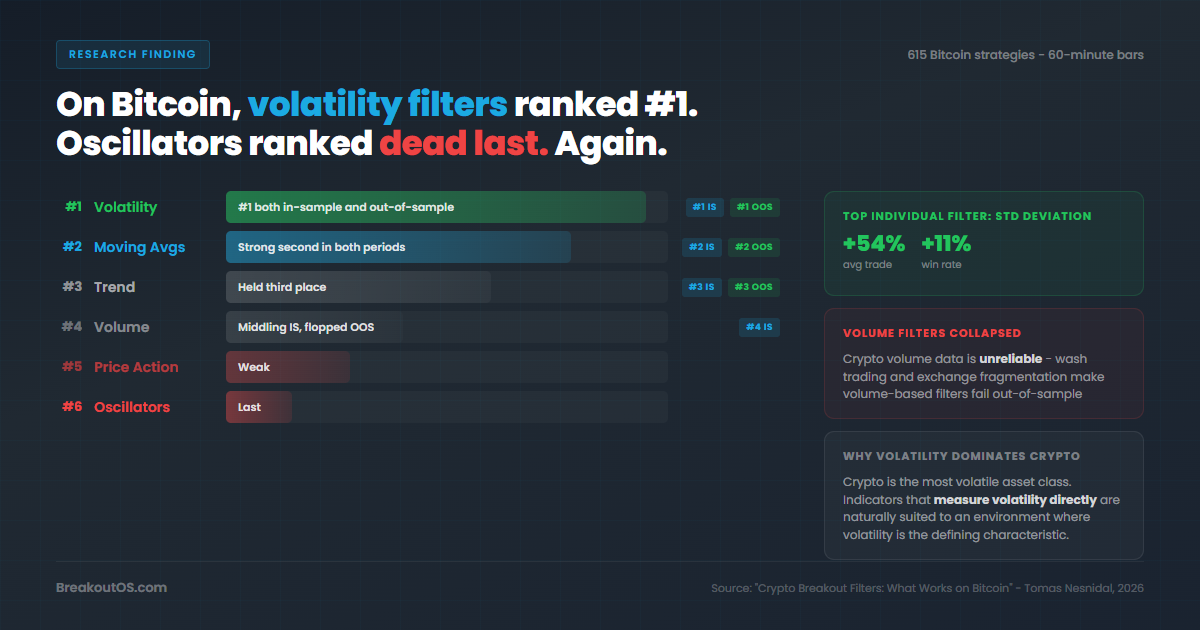
| Rank | In-Sample | Out-of-Sample |
|---|---|---|
| 1 | Volatility | Volatility |
| 2 | Moving Averages | Moving Averages |
| 3 | Trend | Trend |
| 4 | Volume | Price Action |
| 5 | Price Action | Volume |
| 6 | Oscillators | Oscillators |
The headline finding: volatility-based indicators dominated both in-sample and out-of-sample. This was not a close call. Volatility filters produced the highest Uplift Index by a clear margin.
Moving averages came in second in both periods - simple, robust, and consistent. Trend indicators (like ADX) held third place, which makes sense for a market that trends as aggressively as Bitcoin.
What Failed on Crypto
Oscillators finished last in both in-sample and out-of-sample testing. RSI, stochastics, and their variants simply do not work as filters for crypto breakout strategies. If you are using RSI to filter Bitcoin trades, the data from 615 strategies says stop.
Volume indicators told an interesting story. They were middling in-sample but actually fell further out-of-sample. Crypto volume data is unreliable due to wash trading and exchange fragmentation, which likely explains why volume-based filters do not generalize well on Bitcoin.
The Top Individual Filters for Crypto
#1: True Range / ATR
ATR-based conditions consistently appeared among the highest-performing filters across the entire dataset. This is not just a crypto finding - ATR has shown up as a top performer on every market I have tested through BreakoutOS (indexes, commodities, currencies).
ATR works so well as a breakout filter because it directly answers the question every breakout trader needs answered: is the market volatile enough right now for a breakout to follow through? When ATR is elevated, breakouts have momentum behind them. When ATR is compressed, breakouts are more likely to fail.
#2: Standard Deviation (Condition 56)
The second-best individual filter compared the standard deviation of closing price to its own moving average. The performance numbers:
| Metric | Improvement |
|---|---|
| Average Trade | +54% |
| Win Percentage | +11% |
| Net Profit / Drawdown Ratio | +4.33% |
A 54% improvement in average trade size means each trade captured more than half again as much profit as unfiltered trades. An 11% boost in win percentage is the difference between a marginal strategy and a consistently profitable one.
Both the #1 and #2 filters are volatility measures. This is not coincidence - it is the central finding. Crypto's defining characteristic is its extreme volatility, and indicators that measure and respond to volatility are naturally aligned with the asset class.
How Crypto Filter Results Compare to Index Markets
The BreakoutOS Filters Tester makes cross-market comparison straightforward:
| Finding | NASDAQ (Indexes) | Bitcoin (Crypto) |
|---|---|---|
| Best category | Volume + Moving Averages | Volatility + Moving Averages |
| Worst category | Oscillators | Oscillators |
| Best individual filter | Bar Range / ATR | True Range / ATR |
| Volume filters | Strong positive uplift | Unreliable out-of-sample |
| Oscillators | Degraded performance | Dead last both periods |
The overlap is significant. ATR-based filters and moving averages work across both market types. Oscillators fail across both. The main difference is that volume filters, which work well on indexes with reliable exchange data, fall apart on crypto where volume data is questionable.
This kind of cross-market analysis is built into the BreakoutOS workflow. You are not guessing whether an indicator that works on NASDAQ also works on Bitcoin. You test it, measure it with the Uplift Index, and compare.
Practical Steps for Crypto Strategy Development
Based on 615 tested strategies and 100 indicators on Bitcoin:
- Start with an ATR-based filter. If you add nothing else, add a condition that measures whether current volatility is above or below its recent average. This single addition produced the largest improvement across the dataset.
- Add a moving average as a trend filter. Moving averages ranked second and are simple to implement. Combined with a volatility filter, you have the two most reliable filter categories for crypto.
- Drop oscillators entirely. RSI and stochastics have no place in crypto breakout strategies according to this data. Every oscillator condition tested either had no effect or made results worse.
- Be skeptical of volume-based filters on crypto. Until crypto volume data becomes more reliable, volume indicators are unreliable as systematic filters.
- Always split into in-sample and out-of-sample. Several categories looked acceptable in-sample but fell apart on unseen data. The BreakoutOS Filters Tester handles this split automatically.
Related Research
100 Trading Indicators Tested Across 4,100+ Strategies: What Actually Works - The full quantitative study covering indicator performance across both NASDAQ and Bitcoin, including the crypto-specific results referenced in this article.
See BreakoutOS in Action
Watch a full strategy build from blank slate to validated model.
Watch Demo Videos →Frequently Asked Questions

About the Author
Tomas Nesnidal, known to the systematic trading community as Mr. Breakouts, is a breakout trading specialist, hedge fund co-founder, and creator of BreakoutOS. He has managed institutional portfolios using breakout strategies for over 15 years, trading from 65+ countries. He is the author of The Breakout Trading Revolution and co-founder of Breakout Trading Academy.